Loading this page
← Equestrian Performance Initiative

scoring · coaching · data

Where Each Level Loses Its Points

Movement by movement and level by level, on 22,271 rides with movement scores in our records. From Third Level to Grand Prix, the lowest-scoring movement at every level we report is a flying change in some form. Below that, it is the stretch circle at Training, the transitions into canter at First and the half turn on the haunches at Second. At seven of the eight levels, the highest-scoring movement is the final halt and salute.

Across all the levels together, the flying changes are among the lowest-scoring movements with a coefficient of 2. A Training Level test has no flying changes in it.

Level by level, from Training to Grand Prix, the answer changes as you move up, and from Third Level on it settles.

The lowest and the highest, level by level
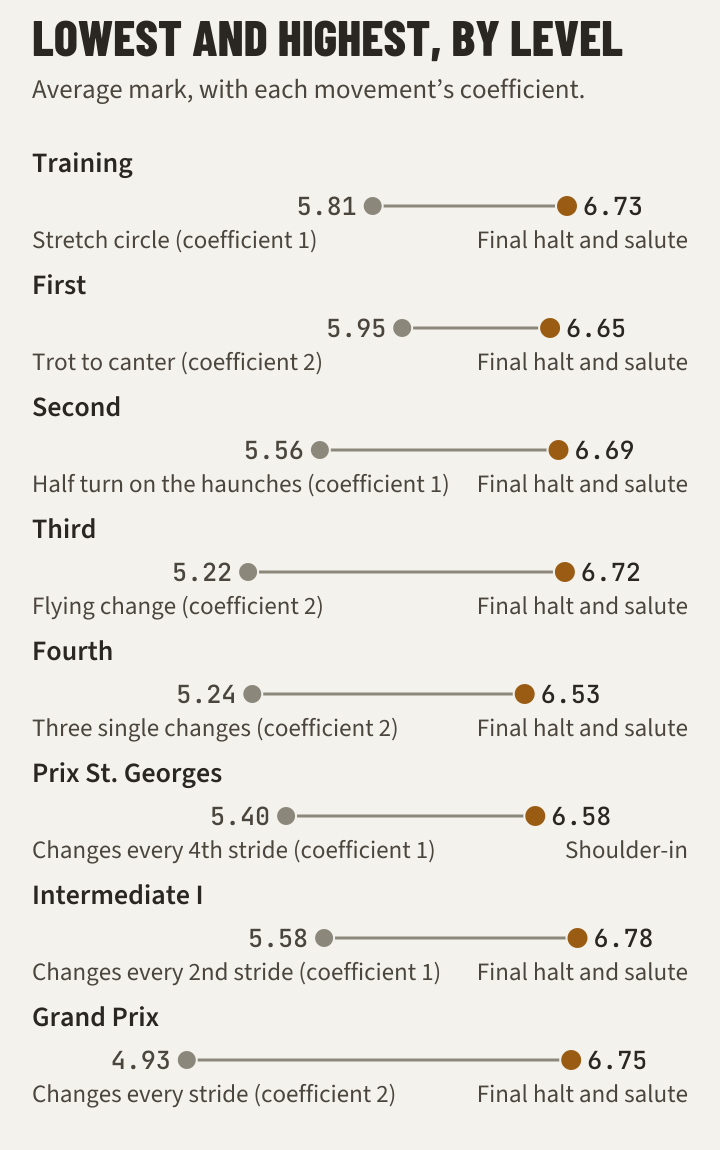
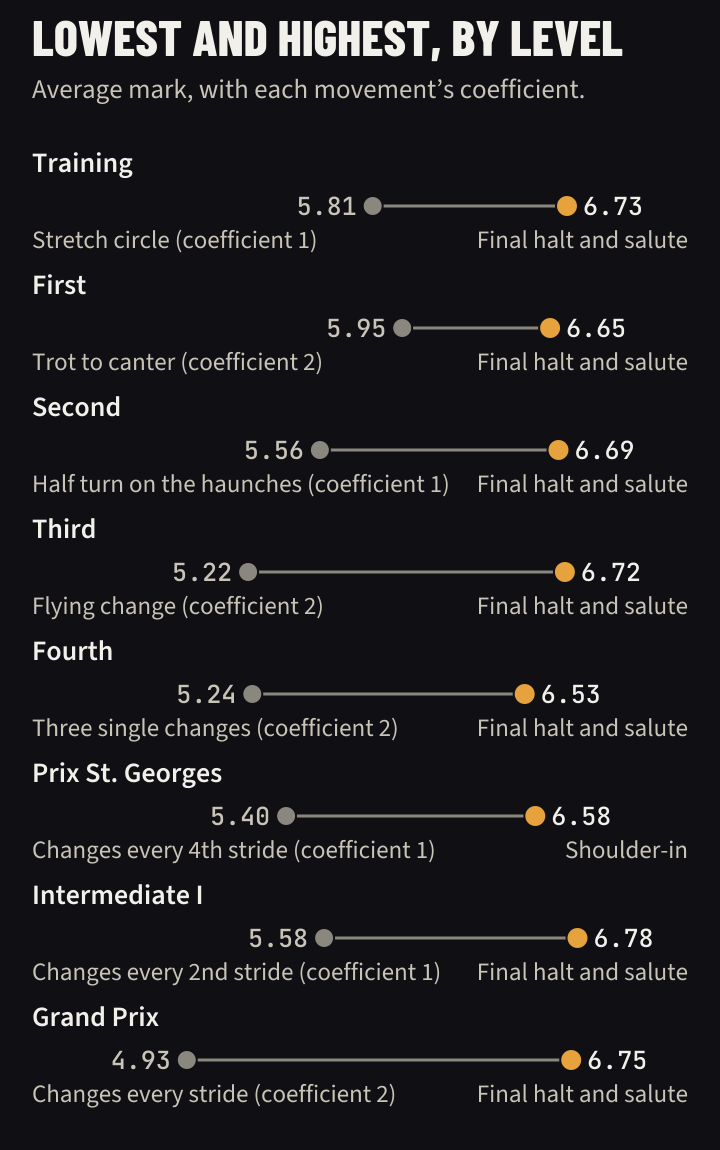
Chart of the lowest and highest average mark at each level. Training: stretch circle, coefficient 1, 5.81, final halt and salute 6.73. First: transition from trot to canter, coefficient 2, 5.95, final halt and salute 6.65. Second: half turn on the haunches, coefficient 1, 5.56, final halt and salute 6.69. Third: flying change, coefficient 2, 5.22, final halt and salute 6.72. Fourth: three single flying changes on the diagonal, coefficient 2, 5.24, final halt and salute 6.53. Prix St. Georges: flying changes every 4th stride, coefficient 1, 5.40, shoulder-in 6.58. Intermediate I: flying changes every 2nd stride, coefficient 1, 5.58, final halt and salute 6.78. Grand Prix: flying changes every stride, coefficient 2, 4.93, final halt and salute 6.75.Chart of the lowest and highest average mark at each level. Training: stretch circle, coefficient 1, 5.81, final halt and salute 6.73. First: transition from trot to canter, coefficient 2, 5.95, final halt and salute 6.65. Second: half turn on the haunches, coefficient 1, 5.56, final halt and salute 6.69. Third: flying change, coefficient 2, 5.22, final halt and salute 6.72. Fourth: three single flying changes on the diagonal, coefficient 2, 5.24, final halt and salute 6.53. Prix St. Georges: flying changes every 4th stride, coefficient 1, 5.40, shoulder-in 6.58. Intermediate I: flying changes every 2nd stride, coefficient 1, 5.58, final halt and salute 6.78. Grand Prix: flying changes every stride, coefficient 2, 4.93, final halt and salute 6.75.

Two things stand out. From Third Level up, the bottom of the chart is always a flying change. And at seven of the eight levels, the top is the final halt and salute.

From Third Level up: the changes
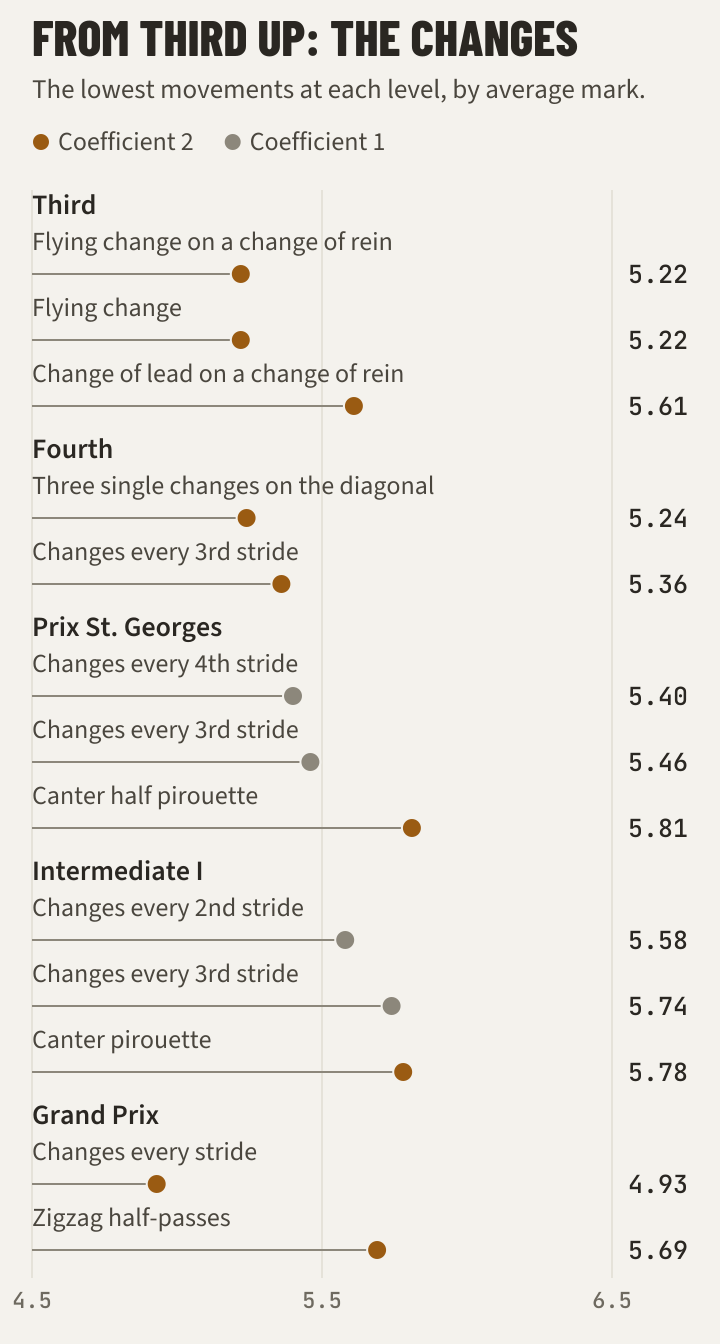
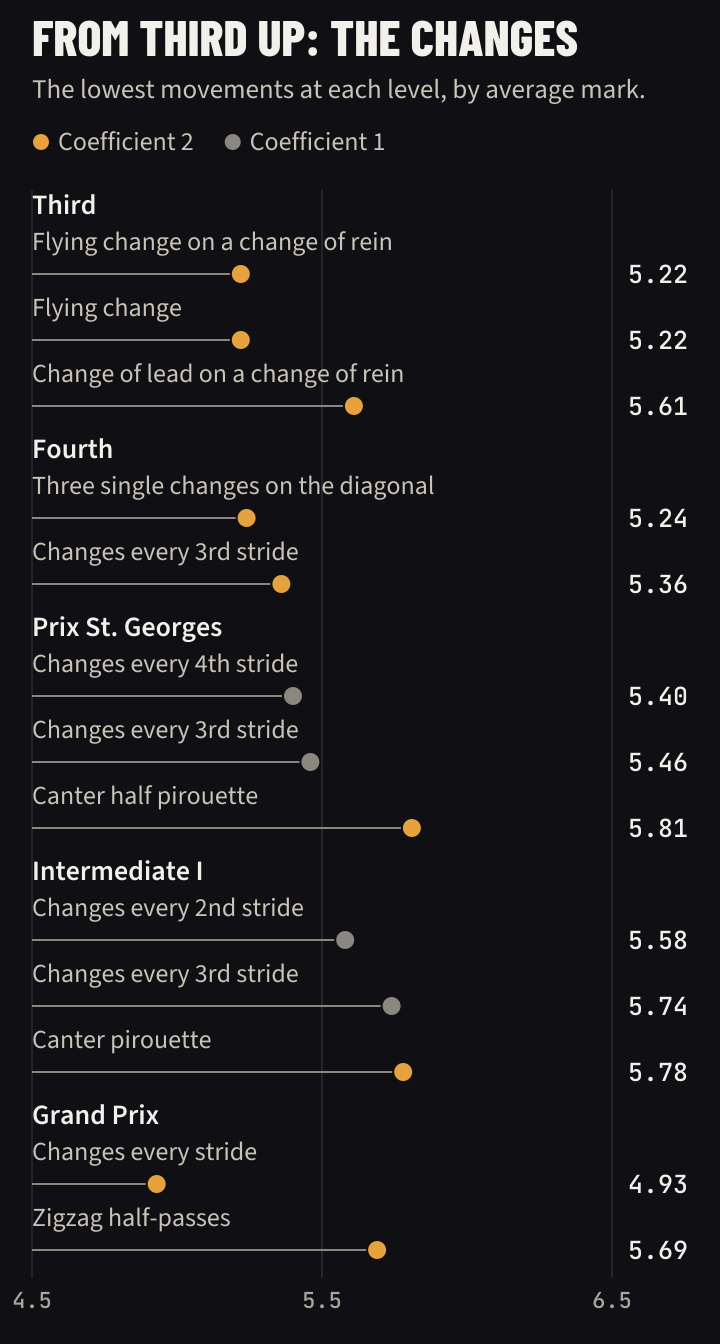
Dot chart of the lowest movements at each level from Third up, by average mark. Third: flying change on a change of rein, coefficient 2, 5.22; flying change, coefficient 2, 5.22; change of lead on a change of rein, coefficient 2, 5.61. Fourth: three single flying changes on the diagonal, coefficient 2, 5.24; flying changes every 3rd stride, coefficient 2, 5.36. Prix St. Georges: flying changes every 4th stride, coefficient 1, 5.40; flying changes every 3rd stride, coefficient 1, 5.46; canter half pirouette, coefficient 2, 5.81. Intermediate I: flying changes every 2nd stride, coefficient 1, 5.58; flying changes every 3rd stride, coefficient 1, 5.74; canter pirouette, coefficient 2, 5.78. Grand Prix: flying changes every stride, coefficient 2, 4.93; zigzag half-passes, coefficient 2, 5.69.Dot chart of the lowest movements at each level from Third up, by average mark. Third: flying change on a change of rein, coefficient 2, 5.22; flying change, coefficient 2, 5.22; change of lead on a change of rein, coefficient 2, 5.61. Fourth: three single flying changes on the diagonal, coefficient 2, 5.24; flying changes every 3rd stride, coefficient 2, 5.36. Prix St. Georges: flying changes every 4th stride, coefficient 1, 5.40; flying changes every 3rd stride, coefficient 1, 5.46; canter half pirouette, coefficient 2, 5.81. Intermediate I: flying changes every 2nd stride, coefficient 1, 5.58; flying changes every 3rd stride, coefficient 1, 5.74; canter pirouette, coefficient 2, 5.78. Grand Prix: flying changes every stride, coefficient 2, 4.93; zigzag half-passes, coefficient 2, 5.69.

At Third Level the changes have a coefficient of 2. At Fourth, the three single changes on the diagonal and the changes every third stride both have a coefficient of 2. At Prix St. Georges, Intermediate I and Grand Prix, the lowest box is a line of tempi changes: every fourth stride, every second stride and every stride. Only the Grand Prix line has a coefficient of 2; the other two have a coefficient of 1.

Beside the lines of changes sit the canter half pirouettes at Prix St. Georges, the canter pirouettes at Intermediate I and the canter zigzag at Grand Prix, half-passes with a flying change at each change of direction. All three have a coefficient of 2.

Below Third Level: the stretch, the canter transitions, the half turn
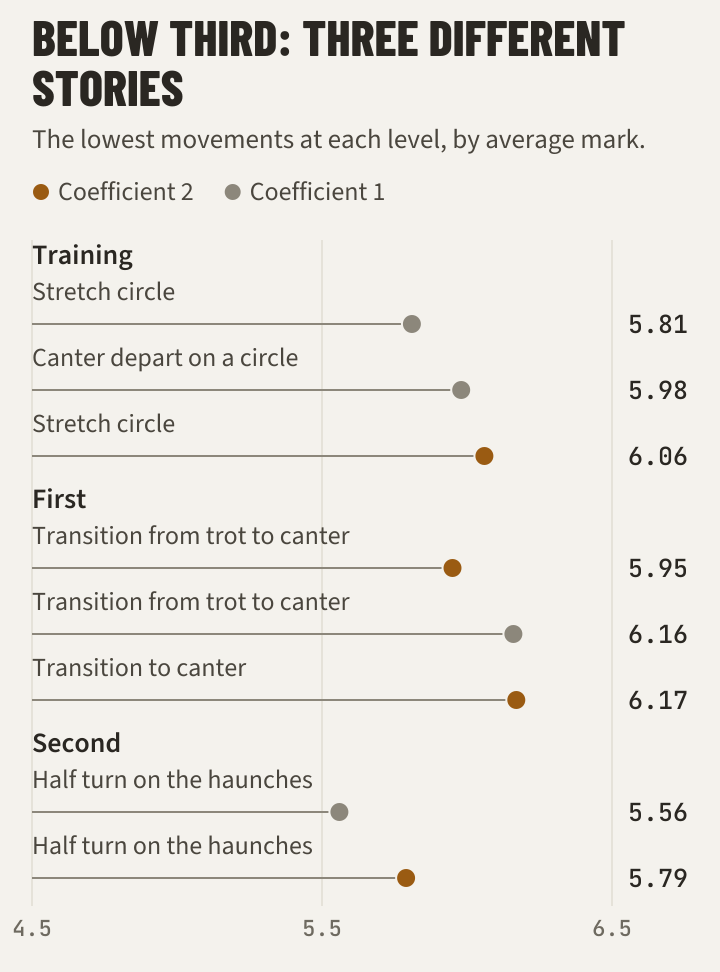
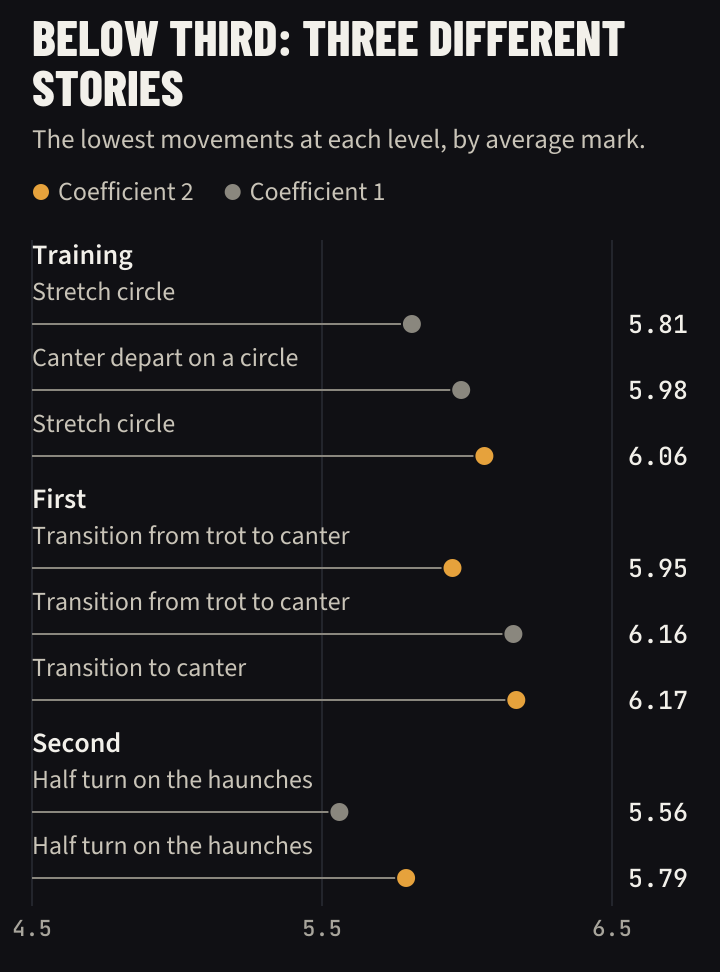
Dot chart of the lowest movements below Third Level, by average mark. Training: stretch circle, coefficient 1, 5.81; canter depart on a circle, coefficient 1, 5.98; stretch circle, coefficient 2, 6.06. First: transition from trot to canter, coefficient 2, 5.95; transition from trot to canter, coefficient 1, 6.16; transition to canter, coefficient 2, 6.17. Second: half turn on the haunches, coefficient 1, 5.56; half turn on the haunches, coefficient 2, 5.79.Dot chart of the lowest movements below Third Level, by average mark. Training: stretch circle, coefficient 1, 5.81; canter depart on a circle, coefficient 1, 5.98; stretch circle, coefficient 2, 6.06. First: transition from trot to canter, coefficient 2, 5.95; transition from trot to canter, coefficient 1, 6.16; transition to canter, coefficient 2, 6.17. Second: half turn on the haunches, coefficient 1, 5.56; half turn on the haunches, coefficient 2, 5.79.

Training. The stretch circle is the lowest-scoring movement where it has a coefficient of 1, and still among the three lowest where it has a coefficient of 2.

First. All three of the lowest are transitions into canter. The lowest box holds two transitions, into trot and then into canter, and has a coefficient of 2.

Second. The half turn on the haunches is the lowest where it has a coefficient of 1 and the second-lowest where it has a coefficient of 2.

The halts score highest

The final halt and salute is the highest-scoring movement at seven of the eight levels, averaging from 6.53 to 6.78. At Prix St. Georges the highest is the shoulder-in. The entry halt ranks among the three highest at First, Second and Third.

The halt itself is one short element, and at First Level Tests 1 and 3 its box also takes in the half circle onto the centerline. Other high-scoring boxes:
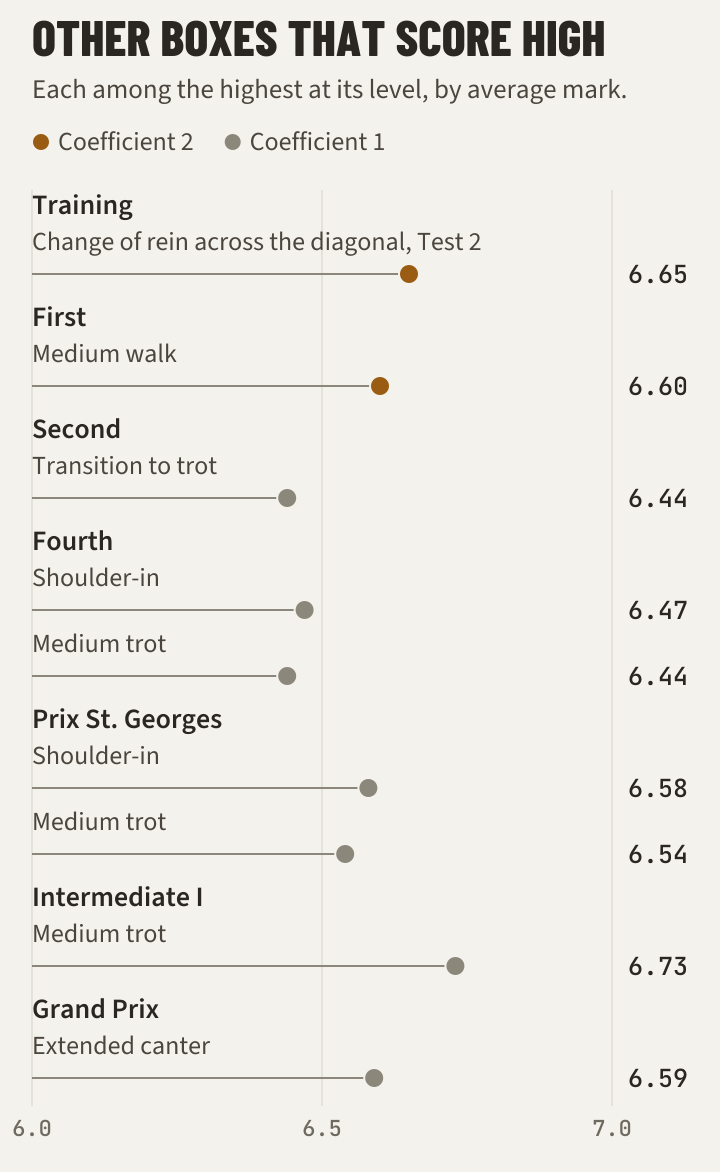
Dot chart of other high-scoring boxes, by average mark. Training: change of rein across the diagonal in Test 2, coefficient 2, 6.65. First: medium walk, coefficient 2, 6.60. Second: transition to trot, coefficient 1, 6.44. Fourth: shoulder-in, coefficient 1, 6.47; medium trot, coefficient 1, 6.44. Prix St. Georges: shoulder-in, coefficient 1, 6.58; medium trot, coefficient 1, 6.54. Intermediate I: medium trot, coefficient 1, 6.73. Grand Prix: extended canter, coefficient 1, 6.59.Dot chart of other high-scoring boxes, by average mark. Training: change of rein across the diagonal in Test 2, coefficient 2, 6.65. First: medium walk, coefficient 2, 6.60. Second: transition to trot, coefficient 1, 6.44. Fourth: shoulder-in, coefficient 1, 6.47; medium trot, coefficient 1, 6.44. Prix St. Georges: shoulder-in, coefficient 1, 6.58; medium trot, coefficient 1, 6.54. Intermediate I: medium trot, coefficient 1, 6.73. Grand Prix: extended canter, coefficient 1, 6.59.

Movements with a coefficient of 2, level by level

Across all levels together, movements with a coefficient of 2 score lower than the rest. Taken level by level, the gap changes size:
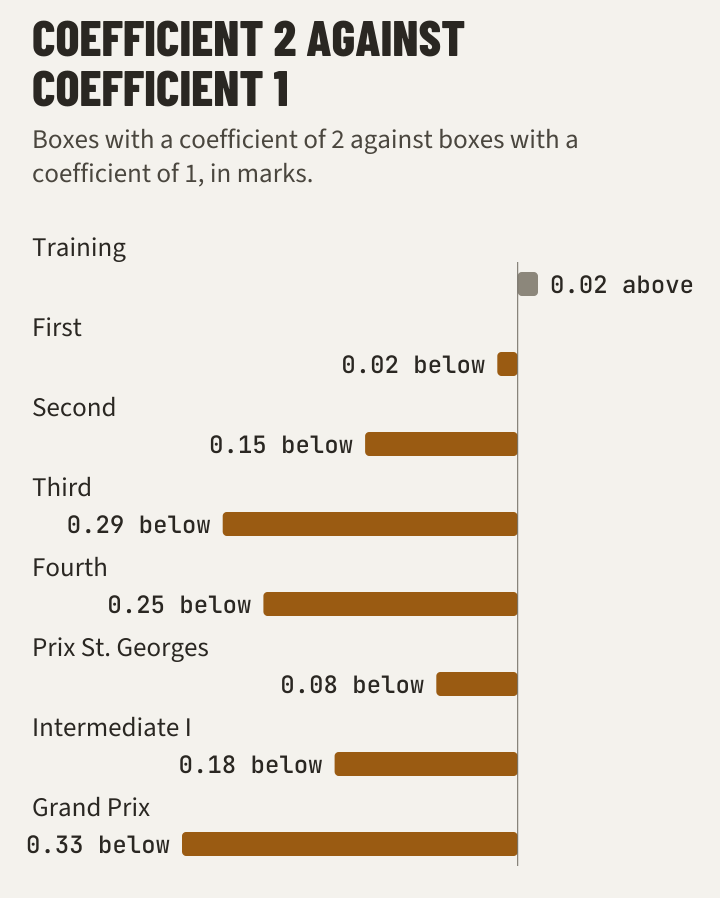
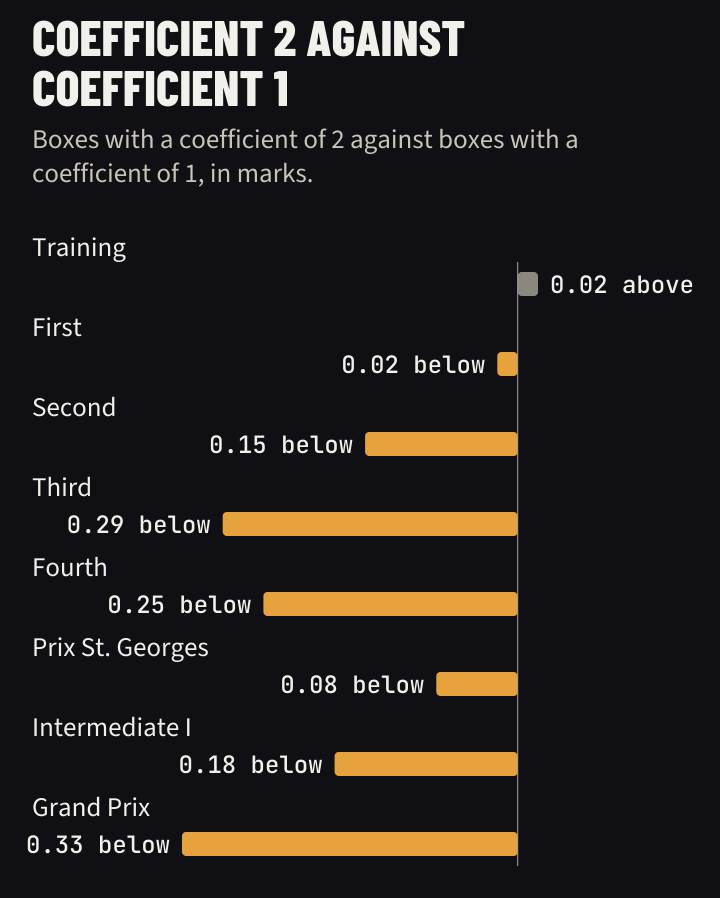
Bar chart of how far the average mark on boxes with a coefficient of 2 sits below boxes with a coefficient of 1. Training, 0.02 above. First, 0.02 below. Second, 0.15 below. Third, 0.29 below. Fourth, 0.25 below. Prix St. Georges, 0.08 below. Intermediate I, 0.18 below. Grand Prix, 0.33 below.Bar chart of how far the average mark on boxes with a coefficient of 2 sits below boxes with a coefficient of 1. Training, 0.02 above. First, 0.02 below. Second, 0.15 below. Third, 0.29 below. Fourth, 0.25 below. Prix St. Georges, 0.08 below. Intermediate I, 0.18 below. Grand Prix, 0.33 below.

On this chart the boxes with a coefficient of 2 run clearly lower from Second up, most of all at Third, Fourth and Grand Prix. At First the gap is small. At Training it turns round: the boxes there include the walks, the single loops and Test 2's trot changes of rein, and they average slightly above the rest.

A coefficient of 2 works the same way at every level: a 5 on that movement weighs as much as a pair of 5s elsewhere.

Against your own average

The charts above compare movements across many riders. This one asks a different question: on one sheet, how does a movement score against the rest of that rider’s test? The horse, the rider, the judges and the day are the same on both sides, so what is left is how that one movement compares with the rest of the ride.
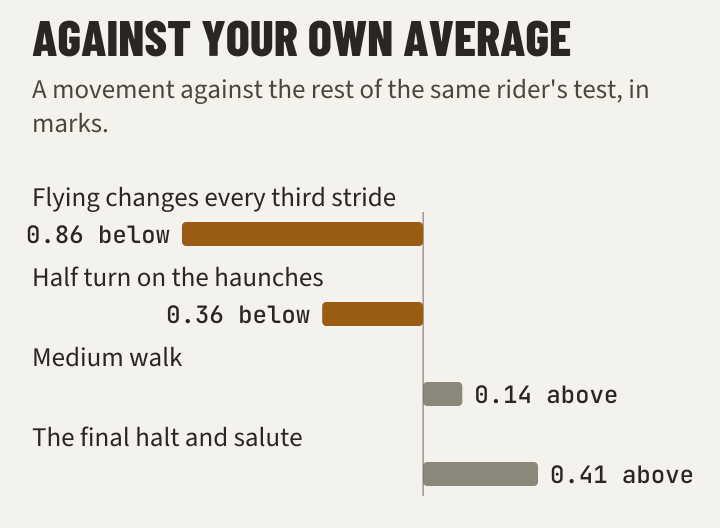
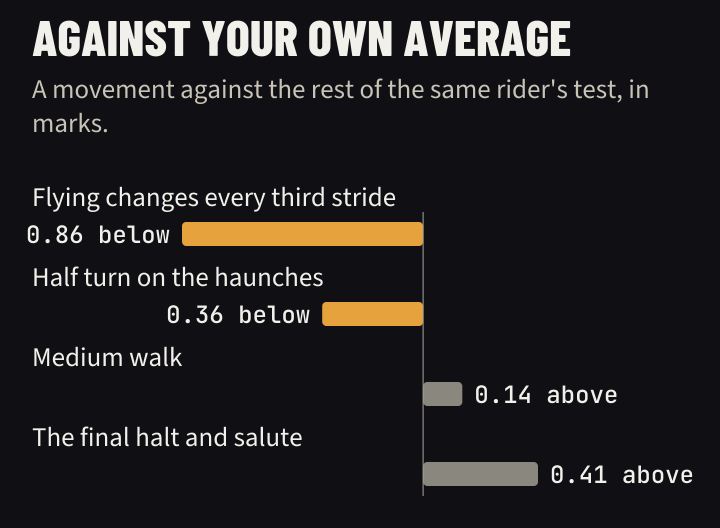
Bar chart of four common movements against the rider’s own average on the same test, in marks. Flying changes every third stride, 0.86 below, on 3,496 rides. Half turn on the haunches, 0.36 below, on 5,472 rides. Medium walk, 0.14 above, on 13,718 rides. The final halt and salute, 0.41 above, on 22,267 rides.Bar chart of four common movements against the rider’s own average on the same test, in marks. Flying changes every third stride, 0.86 below, on 3,496 rides. Half turn on the haunches, 0.36 below, on 5,472 rides. Medium walk, 0.14 above, on 13,718 rides. The final halt and salute, 0.41 above, on 22,267 rides.

What a gap is worth depends on the sheet. Worked through the 2027 sheets, with the average gap at that sheet’s level:

  • Flying changes every third stride, Fourth Level Test 3, where they have a coefficient of 2: about 0.50 percentage points below.
  • Half turn on the haunches, Third Level Test 1, two boxes, each with a coefficient of 1: about 0.15 below.
  • The final halt and salute, Training Level Test 1: about 0.16 above.
  • Medium walk, Training Level Test 1, where it has a coefficient of 2: about 0.13 above.

Your own gap on any movement can be larger, smaller or the other way round.


Source: DPI’s results database; the 2027 test sheets on usdf.org.

See what we have built and leave us an address for an invitation.