tests · scoring
What Half a Mark Is Worth on the New Tests
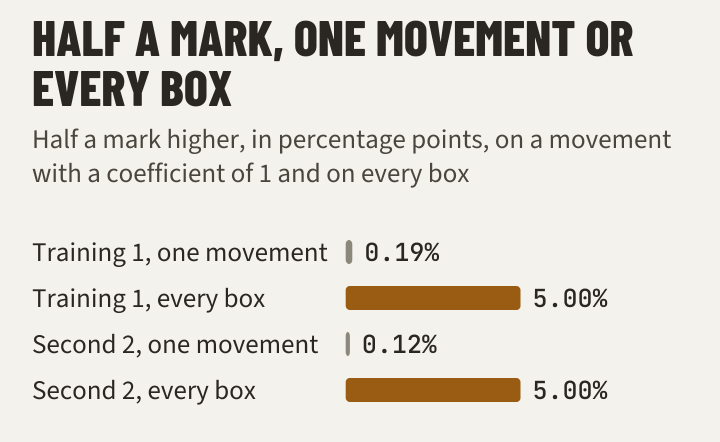
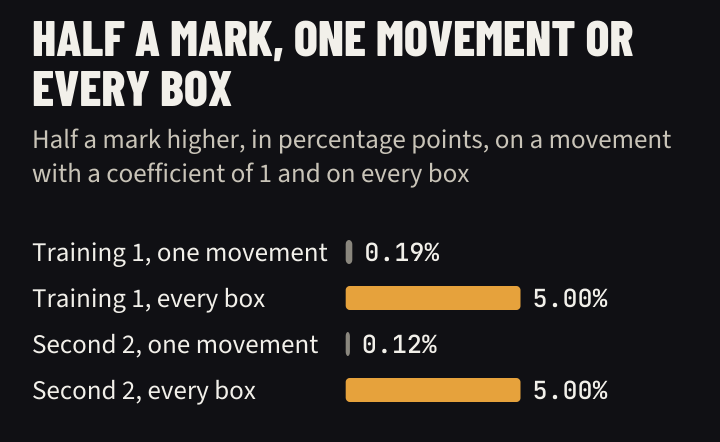
On the 2027 national tests, half a mark higher on one movement adds 0.12 to 0.19 of a percentage point, depending on the test. Half a mark higher on every box adds 5 percentage points, on every test.
On Training Level Test 1, half a mark higher on one movement adds 0.19 of a percentage point. Half a mark higher on every movement and every collective mark adds 5 percentage points: a 63% becomes a 68%.
On the 2027 national tests, which start on 1 December, the first figure runs from 0.12 to 0.19 of a percentage point, depending on the test. The second is 5 on every test.
Why the same mark moves the score by different amounts
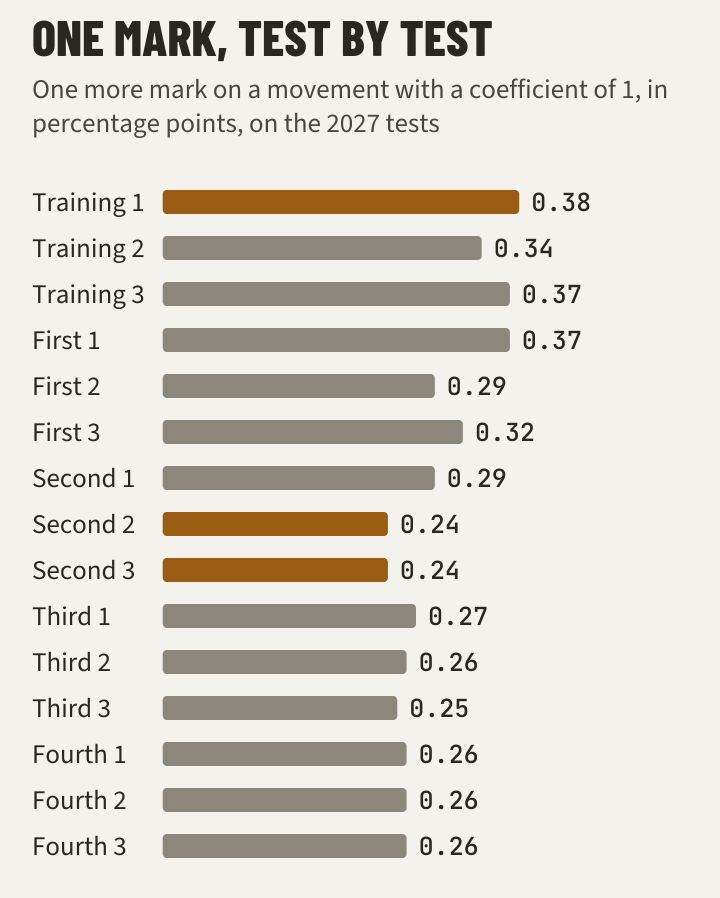
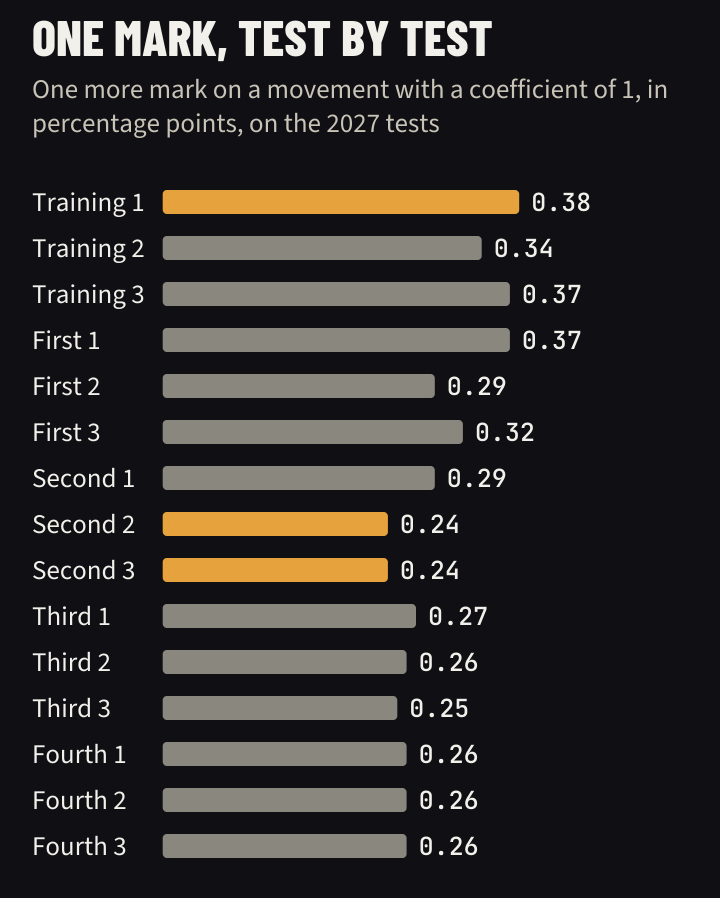
Every sheet adds up its points and divides by its maximum. Training Level Test 1 has a maximum of 260 points, so one mark is 0.38 of a percentage point and half a mark 0.19. Second Level Tests 2 and 3 have a maximum of 410, so one mark there is 0.24 and half a mark 0.12.
The more boxes a test has, the less each one moves the total.
Coefficients on the 2027 sheets
Every 2027 sheet from Training to Fourth Level has between five and nine movements with a coefficient of 2, and among the collective marks, Impulsion and Submission have one. One more mark on a movement with a coefficient of 2 is worth 0.49 to 0.77 of a percentage point, depending on the test, and half a mark 0.24 to 0.38.
In six tests, movements gained a coefficient of 2:
- Training Level Test 3: both 20 m canter circles.
- First Level Test 1: the canter-trot transition on the diagonal (F-X-H).
- First Level Test 2: the trot at K and the left-lead canter depart at A, one mark.
- First Level Test 3: the change of lead through trot (K-X-M).
- Second Level Test 2: both simple changes.
- Third Level Test 2: the transitions into and out of the extended trot.
One judge or three
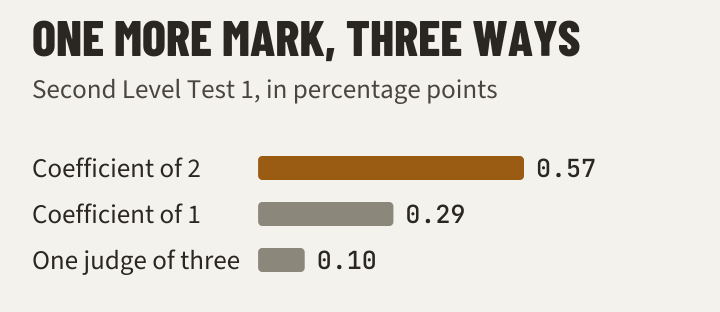
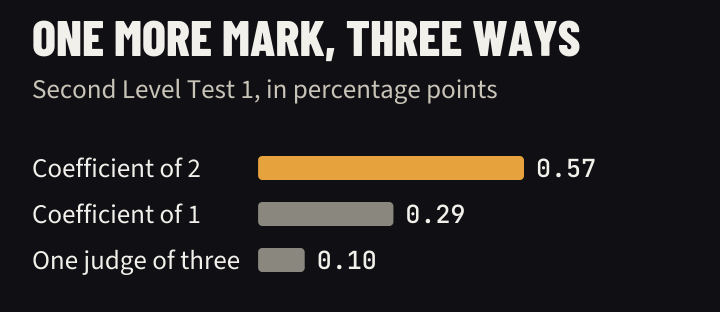
The First Level Adult Amateur title at the 2026 US Dressage Finals was won by 0.046 of a percentage point: 72.639% against 72.593%. That is half a mark from one judge on one movement. The test was the 2023 First Level Test 3, with a maximum of 360 and three judges, where half a mark from one judge on a movement with a coefficient of 1 moves the final score by 0.046.
With one judge, your score is that judge’s sheet. With three, as at a championship, your score is the average of three sheets, so one judge’s extra mark moves the final score a third as far.
Where the maximum moved
Six of the fifteen tests have a new maximum, so a mark there is worth a little more or a little less than it was on the 2023 sheet:
- First Level Test 3: 360 to 310. One mark is now 0.32 of a percentage point, up from 0.28.
- Training Level Test 3: 250 to 270. One mark is now 0.37, down from 0.40.
- First Level Test 2: 330 to 340. One mark is now 0.29, down from 0.30.
- Second Level Test 2: 390 to 410. One mark is now 0.24, down from 0.26.
- Second Level Test 3: 420 to 410. One mark stays at 0.24.
- Fourth Level Test 3: 360 to 380. One mark is now 0.26, down from 0.28.
On the other nine, the maximum and the worth of a mark stay as they were.
What a technical fault costs
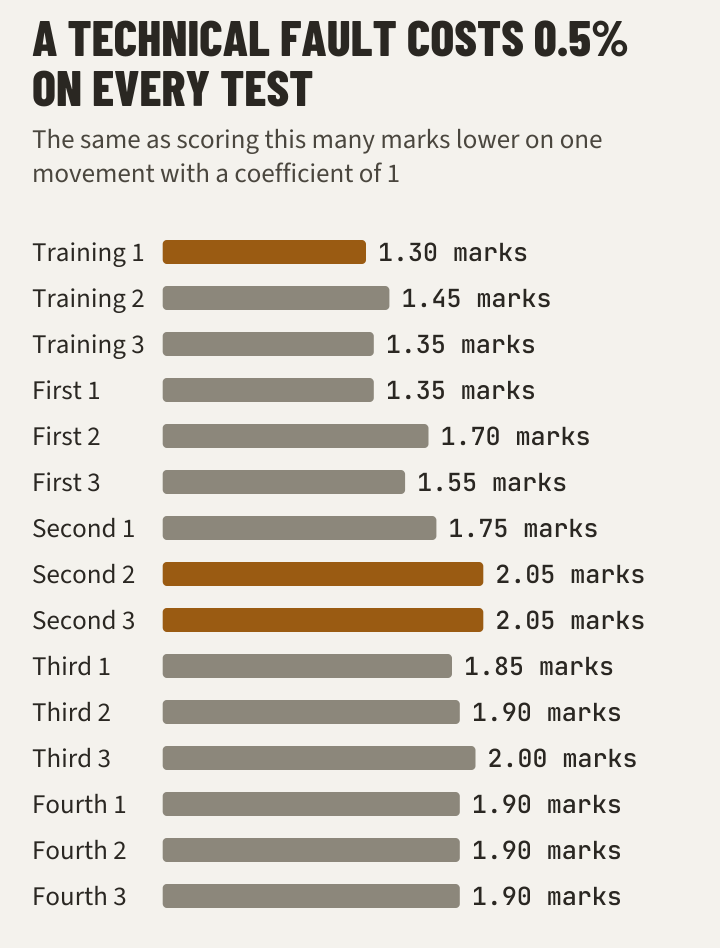
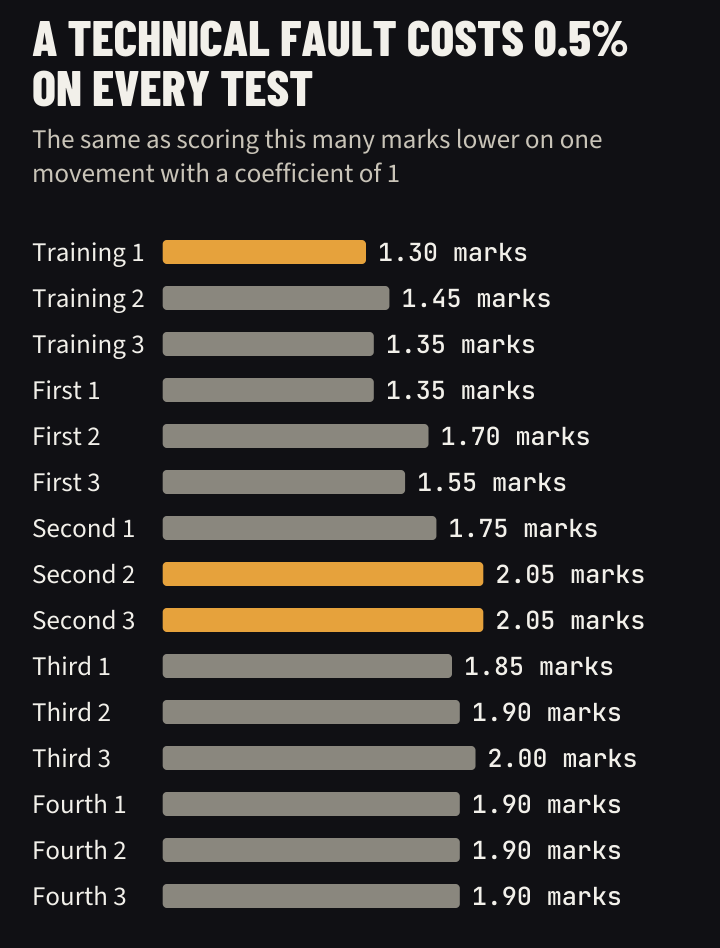
On Second Level Test 2, a 65.00% ride with one technical fault scores 64.50%. Scoring a 5 where you would have had a 7 on one movement costs about the same.
From 1 December, a technical fault takes 0.5% off your final score on every test, and so does using the voice. Test by test, that 0.5% equals this many marks on one movement:
Every half mark, added up
Half a mark on one movement is a fifth of a percentage point at most. Every box on a sheet is marked out of 10, collective marks included, so half a mark higher on every box is 5 percentage points, on every test from Training to Fourth Level.
Sources: the 2023 and 2027 test sheets on usdf.org; the dressage rule changes on usef.org; results on Horse Show Office for the 2026 US Dressage Finals.