tests · scoring · rules
The New National Tests — What Changes on 1 December
From 1 December 2026 the 2027 national tests replace the 2023 set. Four of the fifteen Training-to-Fourth tests were reworked, the coefficients moved in seven, and the collective marks read the same. What changed, test by test, and the rule that puts Third Level in a snaffle.
The national tests change over on 1 December 2026. The 2023 sheets cover competition through 30 November. From 1 December the 2027 set, Introductory through Fourth Level, runs until 30 November 2030. The international tests are revised separately, from 1 January 2027.
Some tests barely changed. Four changed a lot, and in seven the coefficients changed.
How much of each test reads the same
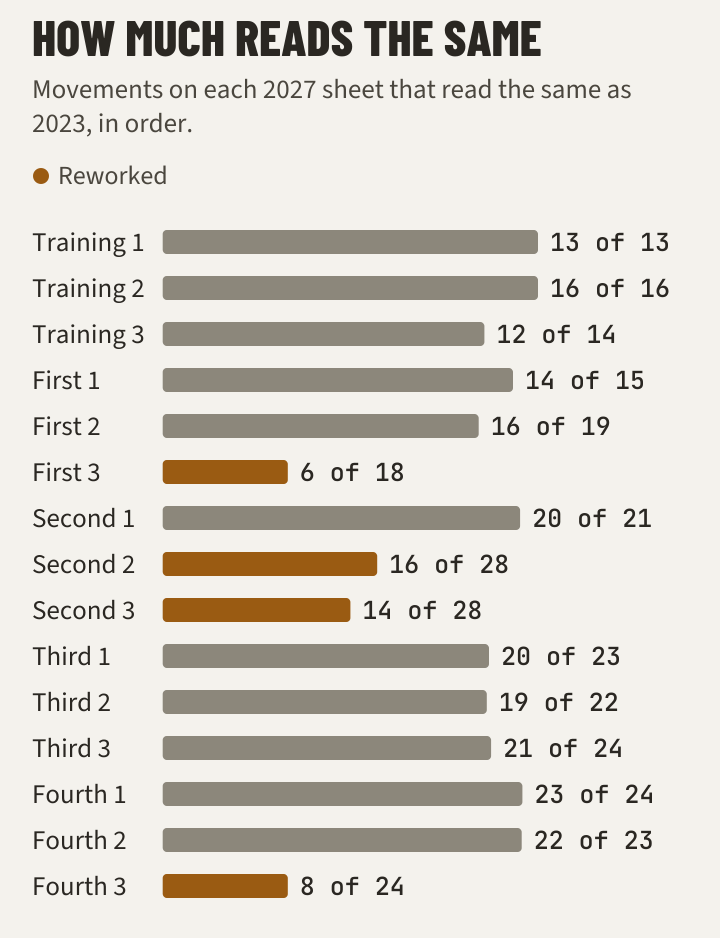
Four tests fall below two-thirds: First 3, Second 2, Second 3 and Fourth 3. Those four are reworked. Introductory C is also restructured, with canter now picked up between two letters and shown on a 20 m circle.
What reads the same
- The collective marks. Training through Fourth Level keep the same five marks and the same coefficients: gaits 1, impulsion 2, submission 2, rider’s position and seat 1, rider’s correct and effective use of aids 1. The Introductory tests keep their six, with the same wording.
- Errors of the course: 2 points off the total the first time, 4 the second, elimination the third.
- The ride times printed on the Training-to-Fourth sheets.
- Five tests, movement for movement. Training 1 and 2 and Fourth 1 and 2 keep their movements, letters and coefficients (Fourth 1 and 2 with small wording differences), and Introductory A keeps its pattern.
Every purpose statement is new
The paragraph at the top of every Introductory-to-Fourth sheet has been rewritten. The new wording asks for ease and harmony at every level. The rule change behind it (DR118.2) puts the horse’s welfare first and says that choosing a level where both horse and rider are competent is the rider’s responsibility.
The levels now ask for this:
- Introductory: beginning to understand correct basics; forward in a correct rhythm and tempo, accepting contact; correct geometry with balance, bend and harmony.
- Training: correct rhythm and steady tempo, confident acceptance of the bit, suppleness with bend on circles and in corners, correct geometry.
- First: willingly on the bit, beginning to move sideways, enough thrust for lengthenings in trot and canter.
- Second: beginning to take weight behind; uphill balance for the collected and medium gaits; equal bend in all lateral work.
- Third: more consistent engagement and collection, cadence in lateral work, fully developed medium gaits, confident acceptance of the flying change aids.
- Fourth: uphill balance and self-carriage with ease, cadence in all trot and canter work, clear differences between collected, medium and extended gaits.
A separate rule change (DR101.1) adds a principle on the welfare and ethical treatment of horses to the general principles of dressage.
What changed, test by test
Introductory
- Intro B: the walk on a long rein crosses the whole diagonal (F-X-H, was F to E), and the trot returns between C and M.
- Intro C: canter is picked up between two letters (F and A, then M and C) on a 20 m circle, and the transitions into and out of canter are marked separately.
Training
- Training 3: trot at C is marked on its own, apart from the second loop. Both 20 m canter circles now have a coefficient of 2, and the medium walk at A has a coefficient of 1.
First
- First 1: the stretch circle moves to the end of the test and keeps its coefficient of 2. The coefficient of 2 moves from the right-lead canter depart to the canter-trot transition on the diagonal.
- First 2: the mark for the trot at K and the left-lead canter depart at A now has a coefficient of 2. The walk is re-routed (medium walk C-M-R, then the long-rein walk R to V), and the right-lead canter is asked for approaching F.
- First 3, reworked: the 15 m canter circles go. The change of lead through trot has a coefficient of 2. The stretch circle moves to the end, at E, and with the right-lead loop has a coefficient of 1.
Second
- Second 1: the final turn onto the centerline is a 10 m half circle.
- Second 2, reworked: shoulder-in, travers and the 10 m half circles between them are marked separately. The two simple changes have a coefficient of 2 and the two counter-canter movements a coefficient of 1.
- Second 3, reworked: the counter-canter serpentines become a half 10 m circle followed by a half 20 m circle in counter canter. The two medium-trot transition marks have a coefficient of 1. The test ends with trot at L on the centerline and the halt at I.
Third
- Third 1: new walk half-turn wording, and one letter changes in a canter transitions mark (K-A-P becomes K-A-F).
- Third 2: the coefficient of 2 moves from the extended trot to the transitions into and out of it, marked at F-A-K. The release of both reins on the 20 m circle at C is 3 to 5 strides (was 4 to 5).
- Third 3: new walk half-turn wording.
Fourth
- Fourth 1: the same movements and coefficients. The introduce box now names canter to halt and the trot counter change of hand.
- Fourth 3, reworked: the walk and canter work are re-routed. The extended canter and the flying change that ends it are marked separately, there is a separate collected-trot mark before the final turn, with the halt at G. The same kinds of work keep a coefficient of 2, in a new order around the arena.
Where the maximum points moved
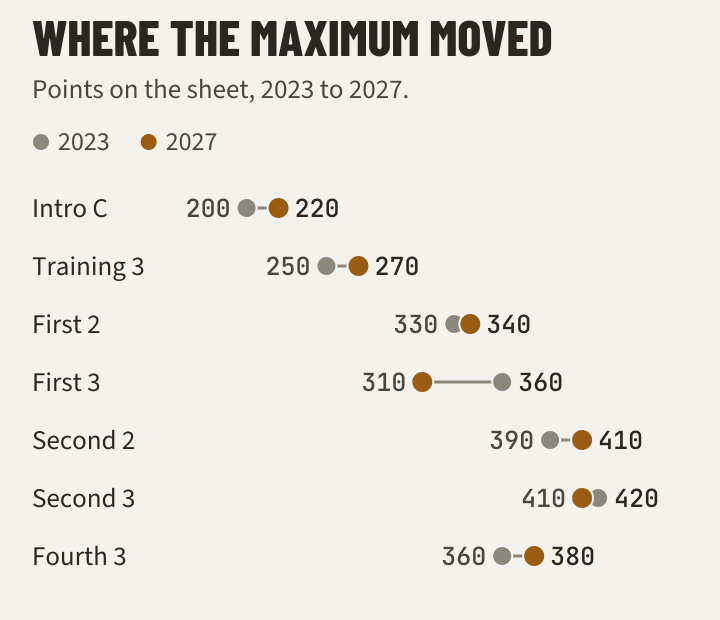
Maximum points only change how the sheet adds up. Your score is still a percentage of the sheet’s maximum.
Where the coefficients moved
The coefficient column is where a test tells you which movements it weighs most. In seven of the fifteen Training-to-Fourth tests, movements gained or lost a coefficient of 2:
- Training 3: both 20 m canter circles (B and E) now have a coefficient of 2. The medium walk at A now has a coefficient of 1.
- First 1: the canter-trot transition on the diagonal (F-X-H) now has a coefficient of 2. The right-lead canter depart at C now has a coefficient of 1.
- First 2: the trot at K and the left-lead canter depart at A, one mark, now have a coefficient of 2.
- First 3: the change of lead through trot (K-X-M) now has a coefficient of 2. The stretch circle and the right-lead loop (K-X-H) now have a coefficient of 1.
- Second 2: both simple changes now have a coefficient of 2. Both counter-canter movements now have a coefficient of 1, and so do the 10 m half circles, which were part of the travers marks with a coefficient of 2.
- Second 3: both medium-trot transition marks (F-A-K, K-A-F) now have a coefficient of 1.
- Third 2: the transitions into and out of the extended trot now have a coefficient of 2. The extended trot (H-X-F) now has a coefficient of 1.
One wording change worth noticing
In the walk half turns of Second 2 and 3 and all three Third Level tests, the 2023 sheets asked you to "collect". The 2027 sheets ask you to shorten the steps in walk and then make the half turn on the haunches. Collected walk itself is still asked for at Fourth Level.
A new penalties line on every sheet
The 2027 sheets, Introductory through Fourth Level, add a technical-faults line: 0.5 percentage points per technical fault.
Rule changes that start the same day
- Third Level is ridden in a snaffle (DR121). At Third Level and below a plain snaffle is required in the warm-up and in the test. A double bridle is allowed from Fourth Level, and para athletes have a separate provision. The 2023 Third and Fourth Level sheets printed "Double Bridle Optional", and the 2027 sheets drop that line.
- Voice is a percentage deduction (DR122.3). Using the voice or clicking costs 0.5 percentage points from the final score, deducted by each judge, in place of marks off the movement. The rule says these deductions are not cumulative, and they do not lead to elimination.
- Spurs (DR120.4). Rowels must be blunt, smooth and rounded, able to rotate, with no rough or sharp edges. The rule names daisy rowels and tines among what is not allowed.
- Bridles (DR121.3). The crownpiece and padding rules are aligned with the international ones.
Freestyles
On the Training, Second and Fourth Level freestyle sheets, the compulsory elements and point totals read the same as in 2023. What changed:
- Music and interpretation are one mark with a coefficient of 4, where there were two marks with a coefficient of 2 each.
- Going over time costs 0.5 percentage points from the artistic total, where the 2023 sheets printed 1 point.
- A technical-faults line takes 0.5 percentage points from the technical total. Not taking the reins in one hand at the salute is listed as a technical fault.
- Medium or lengthened strides on a curved line, where they are allowed, are capped at half a 20 m circle.
- Entry timing. The 2027 sheets drop the printed 30-second limit, and the rulebook and the 2027 guidelines still use 30 seconds. What follows a late entry differs between documents. The rulebook counts entering after 30 seconds of music, but within 90, as a technical fault of 0.5%, and the rule change moves elimination from 75 to 90 seconds after the bell. The 2027 freestyle guidelines set a 0.5% deduction from the artistic total, or elimination at the judge’s discretion, and still say 75 seconds.
Source: the 2023 and 2027 test sheets and the 2027 freestyle guidelines on usdf.org; the dressage rule changes and the 2026 dressage chapter on usef.org.